The case for manufacturing dietary supplements overseas weakened sharply in the past three years. Tariffs on Chinese imports expanded multiple times. Reciprocal tariffs introduced in 2025 hit secondary sourcing countries that brands had used as alternatives. Major retailers including Amazon, Costco, Whole Foods, and Walmart tightened third-party audited GMP requirements. FDA enforcement under 21 CFR Part 111 became more aggressive, with warning letters and import alerts issued against brands using overseas manufacturers that failed inspections. For supplement brand owners launching now, the math that made overseas manufacturing the default has shifted.
The most consequential issue for supplement brands is not tariffs. It is ingredient identity verification, the audited proof that what's in the bottle is what the label says. Overseas manufacturers vary widely on this, and the brand owner is the one FDA holds responsible. A US contract manufacturer with NSF/ANSI 455-2 certification operates with documented identity testing on every raw material lot. That documentation is what protects the brand.
21 CFR Part 111, the FDA's dietary supplement GMP rule, requires manufacturers to verify the identity of every incoming raw material lot before use in production. The verification typically uses methods like HPTLC (high-performance thin-layer chromatography), HPLC, FTIR spectroscopy, or DNA barcoding for botanical ingredients. The test confirms that the raw material is what the supplier claims, that the species or compound matches the specification, and that adulterants are not present.
Overseas manufacturers vary in how rigorously they perform this testing. Some run it on every lot. Some run it on a periodic schedule. Some accept supplier Certificates of Analysis without independent verification. The brand owner carries the product safety responsibility regardless of which approach the manufacturer takes, because FDA's enforcement priority is the brand on the label, not the facility behind it.
The adulteration risk is documented and ongoing. The herbal supplement category has had multiple high-profile incidents where retail products tested did not contain the labeled ingredients. Heavy metals contamination has affected protein powders and plant-based supplements. Banned substance contamination has hit sports nutrition products and removed brands from major retailers' shelves. Each incident generates FDA attention that extends beyond the specific brand involved, raising scrutiny across the category.
A US contract manufacturer with NSF/ANSI 455-2 certification operates under audited identity testing protocols. The annual audit reviews the procedures, the analytical methods used, the lot-by-lot documentation, and the qualification of the testing lab. That documented chain is what brand owners produce when a retailer compliance team, an FDA inspector, or a plaintiff's lawyer asks questions.
The Modernization of Cosmetics Regulation Act gave FDA mandatory facility registration, product listing, adverse event reporting, safety substantiation, records access, and recall authority for cosmetics. The compliance burden falls on the responsible person identified on the label, which is usually the brand owner. When the manufacturer is overseas, the brand owner is responsible for ensuring the foreign facility is FDA-registered, maintains records that align with MoCRA expectations, can produce documentation on request, and operates under GMP standards that meet US enforcement priorities.
Many foreign manufacturers were unfamiliar with MoCRA when it took effect, and some still are. A brand owner using a foreign manufacturer that hasn't fully adapted carries the compliance risk personally. If FDA requests records during an inspection, the brand owner needs to produce them, regardless of where the product was made.
A US-based manufacturer with audited GMP certification (such as NSF/ANSI 455-3) operates with the documentation infrastructure MoCRA expects. The records are in English, in standard US formats, and accessible quickly. When FDA shows up, the documentation chain is short.
Section 301 tariffs on Chinese supplement imports have layered up since 2018, with multiple rate increases through 2025. Reciprocal tariffs introduced in 2025 added exposure on imports from India and Vietnam, two of the largest secondary sourcing countries for both finished supplements and ingredient raw materials.
The supplement industry's reliance on Asian-sourced ingredients (botanical extracts, amino acids, vitamins, minerals) means tariff exposure compounds. The finished goods import faces tariffs. Even US-manufactured product faces input cost pressure when the active ingredients are sourced overseas. A US contract manufacturer can buffer some of this by sourcing through suppliers that maintain domestic warehouse inventory, holding stable pricing across tariff schedule changes. Brands that produce finished goods overseas don't have that cushion.
The other piece is unpredictability. Tariff schedules have changed multiple times in the past eighteen months. Brand owners running quarterly forecasts cannot lock in landed cost with confidence when the input cost is subject to executive action. US manufacturing eliminates that variable on the finished goods side.
Amazon's dietary supplement application program now requires third-party laboratory testing reports, GMP certification documentation, and Certificates of Analysis for many supplement subcategories. Costco's supplier compliance program requires GMP audit verification, with NSF/ANSI 455-2 widely accepted. Whole Foods' supplement standards include specific GMP requirements for vendors. Walmart's Marketplace seller program tightened supplement documentation requirements in 2024 and 2025. Sprouts and The Vitamin Shoppe have parallel programs.
For brand owners, the implication is that selecting a manufacturer without audited GMP certification limits retail distribution before a label is printed. For brands using overseas manufacturers, the documentation chain for retailer compliance is longer, slower, and more often rejected when the underlying audit history doesn't translate cleanly to US standards. A retailer compliance team reviewing supplier documentation can verify NSF/ANSI 455-2 in minutes through NSF's public listings. Verifying an unfamiliar foreign GMP audit takes weeks, sometimes longer.
Standard ocean freight from Asia to the US runs 30 to 45 days transit. Add 8 to 10 weeks for production at the overseas facility, plus customs clearance and domestic distribution, and a brand is committing to inventory levels 16 to 20 weeks out. Forecasting demand at that horizon is hard, especially for new products and seasonal categories like immunity, sleep, and weight management.
Domestic manufacturing collapses the timeline. A US contract manufacturer with available capacity can typically deliver in 4 to 8 weeks for standard supplement formulations (capsules, tablets, gummies, powders, stick packs), plus 1 to 3 days domestic transit. Brands that switch find they can run leaner inventory, respond faster to demand spikes, and iterate on formulations more quickly.
Reformulation cycles compound the lead time difference. A brand iterating on gummy texture, flavor profile, or active concentration faces five or six iteration cycles per year on a domestic timeline, versus two or three on an overseas timeline. For brands trying to dial in product-market fit, the difference is decisive.
Brand owners moving from overseas to domestic supplement manufacturing usually follow a predictable sequence.
First, audit current product specs. The audit captures the formula (active and inactive ingredients with quantities), the supplier list for each ingredient, the testing methods used (identity, potency, contaminants), the manufacturing process flow, and any stability or shelf life data. Many brands manufacturing overseas don't have the full set on file, because the foreign manufacturer holds it. Reconstruction is sometimes necessary.
Second, identify a US contract manufacturer with the relevant certifications, formats, and capacity. The relevant certifications are NSF/ANSI 455-2 (dietary supplement GMP), FDA registration, and any specialized certifications the brand needs (USDA NOP for organic claims, Halal certification, Health Canada registration for the Canadian market, NSF Certified for Sport for sports nutrition). The format match (capsules, tablets, gummies, stick packs, liquids, powders) matters because not every supplement manufacturer handles every format.
Third, run a pilot batch to validate. The pilot confirms identity, potency, dissolution, organoleptic profile (taste, smell, color), and consumer experience.
Fourth, plan the inventory transition. Existing overseas inventory needs to deplete before domestic production fills the channel. Brands typically run a 6 to 10 week overlap.
Fifth, update labeling to reflect the new manufacturing location, manufacturer name, and any FDA-required information that changes (facility address for batch-traceable products, contact information for adverse event reporting).
The full transition typically takes 16 to 20 weeks for supplements, longer than skincare because of the additional testing and stability requirements.
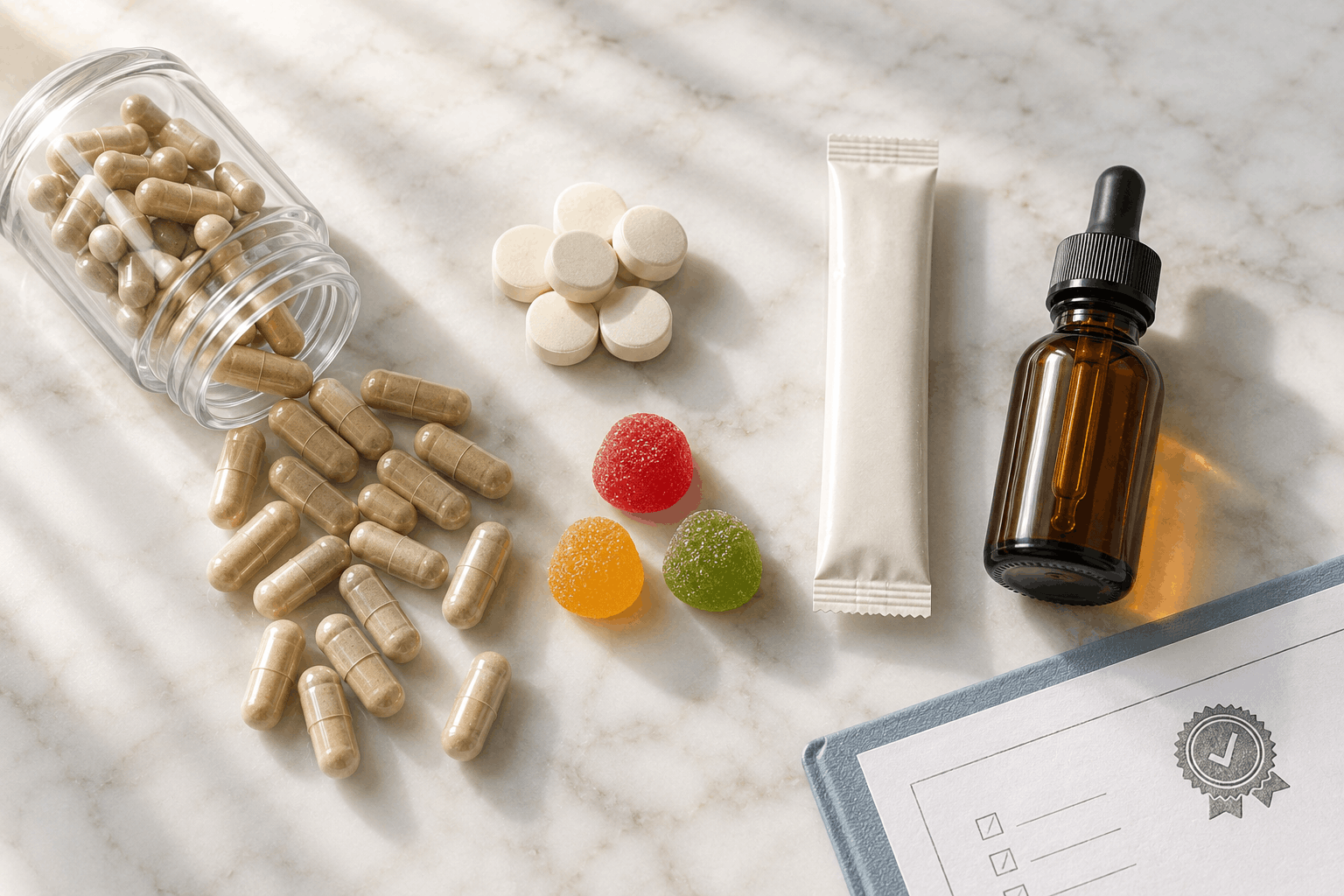
Eagle Labs operates US-based supplement manufacturing in Florida, with NSF/ANSI 455-2 dietary supplement GMP certification at four facilities: the Oldsmar dry powder facility, the Seminole liquids and creams facility, the Almighty Nutrition gummies and liquids facility, and the CORE warehousing operation. Format coverage spans capsules, tablets, chewables, gummies, stick packs, liquids, energy shots, and supplement powders, including sports nutrition formulations.
Coverage extends across the full NSF/ANSI 455 family. Eagle Labs holds 455-3 (cosmetic GMP) and 455-4 (OTC drug manufacturing GMP) at multiple facilities, which means a brand running supplements can add cosmetic, OTC, or hybrid products under the same operating group without switching manufacturers. Eagle Labs is FDA registered, USDA NOP organic certified through OneCert (Certificate 2580006210), Halal certified (HPFR 7334-CH), and Health Canada registered (FSRN 63033).
US-based manufacturing in Florida means brand owners get domestic supply chain control, audited certification coverage, ingredient identity verification on every lot, and shorter documentation chains for retailer compliance and FDA enforcement, all under one roof. Minimum order quantities depend on format, from 5,000 units for powders and liquids to 300,000 for tablets and capsules and 1,000,000 for gummies.
For most supplement brands, tariffs alone close most of the cost gap. Add audited GMP requirements from major retailers, FDA enforcement under 21 CFR Part 111, lead time savings, and ingredient identity verification, and the case for switching is the strongest it has been in years. The exact math depends on volume, format, and current sourcing country, so brand owners should run their own landed-cost comparison before deciding.
Sixteen to twenty weeks is typical. The first four weeks usually go to specification audit and manufacturer selection. The next six to eight weeks cover pilot batch development, identity and potency validation, and short-term stability testing. The remaining six to eight weeks handle production scheduling, label updates, and inventory transition planning.
Usually yes, sometimes with adjustment. US manufacturers may use different raw material suppliers than overseas counterparts, which can shift potency consistency, dissolution profile, taste (for gummies and chewables), or color. A pilot batch identifies these differences. Most brands find the match acceptable after one or two iteration cycles.
Many botanical ingredients are sourced from Asia regardless of where finished manufacturing happens. The difference is the chain of custody. A US contract manufacturer with NSF/ANSI 455-2 certification verifies ingredient identity on every lot, qualifies the supplier under audited procedures, and maintains documentation that satisfies FDA and retailer compliance teams. A foreign manufacturer may or may not, depending on the facility. The ingredient may still travel from Asia, but the verification chain that protects the brand owner is materially different.
Specific requirements vary across Amazon, Costco, Whole Foods, Walmart, Sprouts, and The Vitamin Shoppe, and they update regularly. NSF/ANSI 455-2 is among the most commonly accepted third-party GMP audits. Brands targeting these retailers should verify current requirements directly. The general direction is toward more audited verification, not less.
A meaningful share of supplement gummy production has historically happened in Asia, but US gummy manufacturing capacity has grown rapidly in the past five years. NSF/ANSI 455-2 certified US gummy facilities are now widely available, including Eagle Labs' Almighty Nutrition campus, which holds 455-2, 455-3, and 455-4 certifications. Domestic gummy production also avoids the heat and humidity exposure that long ocean transit imposes on pectin and gelatin formulations.
Yes. Many brands run hybrid models, particularly during transitions. Products to move first are usually those with highest tariff exposure, highest retailer scrutiny, longest current lead times, or most stringent ingredient identity requirements (sports nutrition with banned-substance concerns, herbal supplements with adulteration history, products targeted by Amazon's tightest documentation tiers).
MOQs vary by manufacturer and product type. At Eagle Labs, minimums depend on format: 300,000 units for tablets and capsules (5,000 bottles at a 60-count), 100,000 for stick packs, 5,000 for powders and liquids, and 1,000,000 for gummies. Very low minimums elsewhere usually come with higher per-unit costs and thinner certification coverage, so compare quotes on landed cost and audit status, not the minimum alone.
Read More