Serums have become one of the fastest-growing product categories in skincare. They command higher price points, generate strong repeat purchase behavior, and give brand owners a clear vehicle for ingredient-led positioning. But the formulation complexity behind a well-made serum, whether for skin or hair, is genuinely higher than most topical products. Choosing the right serum manufacturer determines whether your product delivers on its claims or falls short of the market's increasingly demanding standard.
This applies equally to hair serums and massage oils, two adjacent topical categories where formulation expertise and manufacturing quality matter just as much, and where brand owners can build real differentiation with the right partner.
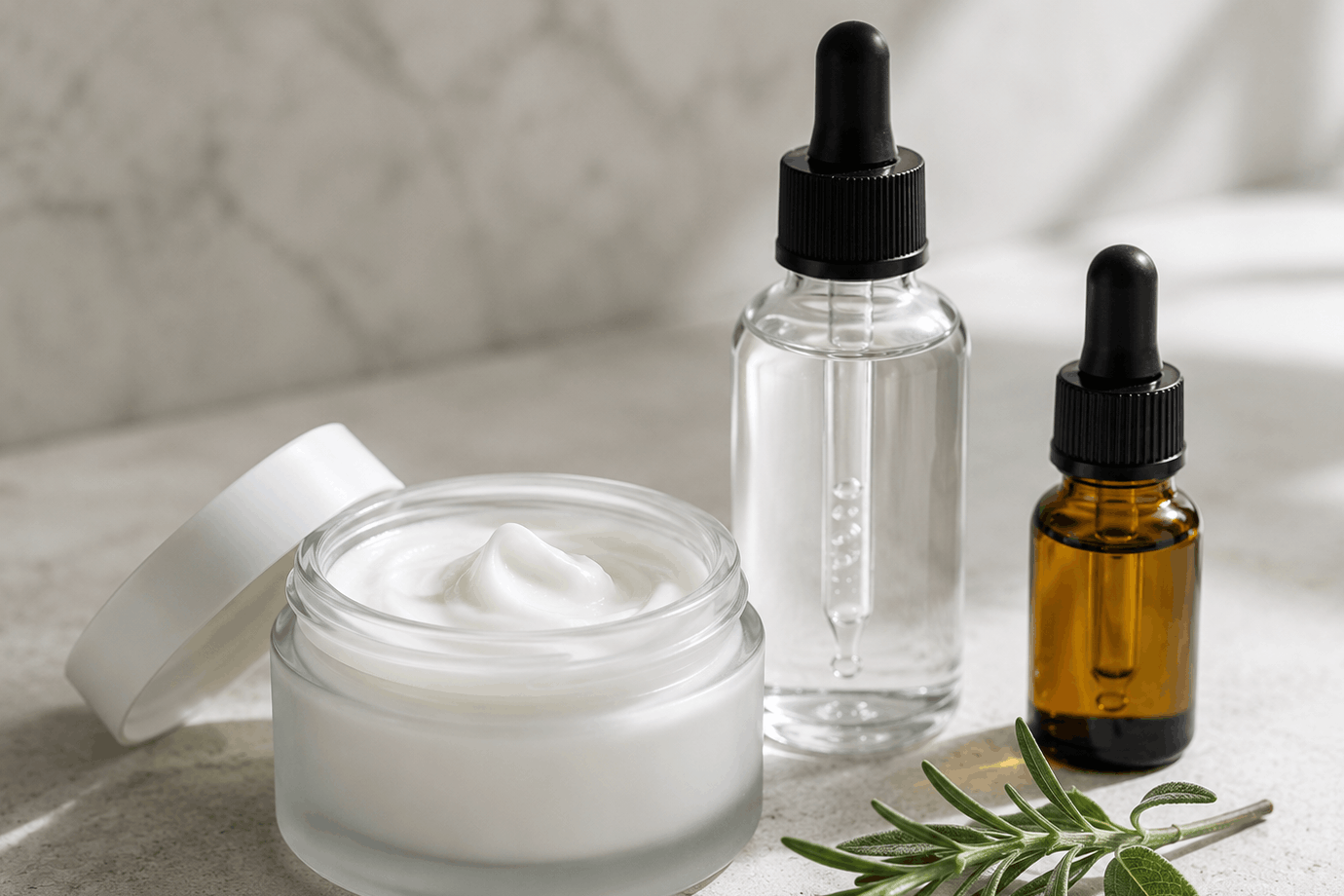
Serums are typically water-based or oil-based formulas with a lightweight, fast-absorbing texture and a higher concentration of active ingredients than a standard cream or lotion. That concentration is the point. Consumers expect visible results, and brands price accordingly.
From a manufacturing standpoint, high-active formulas introduce complexity. Ingredient stability, pH management, and compatibility between actives all require careful formulation work. A contract manufacturer without strong R&D capabilities will struggle to produce serums that are both effective and stable across a product's shelf life.
Vitamin C serums are among the most in-demand and most technically demanding products in the category. Vitamin C (most commonly as L-ascorbic acid) is highly unstable. It oxidizes on contact with air and light, turning the product brown and losing its efficacy. A vitamin C serum manufacturer needs to control pH carefully (L-ascorbic acid is most stable and effective at a low pH), formulate with stabilizing co-ingredients like vitamin E and ferulic acid, and package the product in a way that minimizes oxidation exposure.
For brand owners, this means the quality difference between manufacturers in the vitamin C serum space is substantial. A manufacturer who does not understand ascorbic acid chemistry will give you a product that looks fine on day one and fails within months on shelf or in a consumer's bathroom cabinet.
Beyond vitamin C, skin serums frequently incorporate hyaluronic acid for hydration, niacinamide for tone and texture, retinol for cell turnover, and peptides for anti-aging support. Each brings its own formulation considerations. A capable serum manufacturer can help you build an ingredient stack that works together, performs consistently, and passes stability testing.
Hair serums share a product form with skin serums but are formulated for an entirely different substrate. Where skin serums focus on penetration and cellular activity, hair serums are designed to coat, protect, and treat the hair shaft and, in many cases, address scalp health.
Common hair serum ingredients include silicones like dimethicone and cyclomethicone, which create slip and shine while reducing frizz. Argan oil, marula oil, and jojoba oil are popular among brands pursuing a natural or clean-label positioning. Ingredients like biotin, keratin, and caffeine are commonly incorporated in scalp health serums targeting hair density and growth support.
From a manufacturing perspective, hair serums are typically lighter in viscosity than skin serums and require precise emulsification or solubilization depending on their oil and water content. Stability testing is equally important, since phase separation or ingredient degradation creates a product that will fail in the market regardless of how well it performs at launch.
Brand owners building a hair care line need a contract manufacturer who has experience with both the cosmetic chemistry side and the regulatory requirements specific to hair products, particularly if any efficacy claims are involved.
Massage oils occupy an interesting corner of the topical market. They are positioned at the intersection of wellness, self-care, and luxury, and they command strong margins when formulated and branded well.
The formulation basis for massage oils is carrier oils, typically combinations of sweet almond oil, jojoba oil, grapeseed oil, fractionated coconut oil, or sunflower oil, selected for their skin feel, absorption rate, and stability. Essential oils are frequently blended in for scent and targeted wellness positioning (lavender for relaxation, eucalyptus for muscle recovery, rosemary for circulation). Vitamins A and E are common additions that serve both functional and marketing purposes.
From a manufacturing standpoint, oil-based formulas require attention to oxidative stability. Oils high in polyunsaturated fatty acids can go rancid if antioxidants are not properly incorporated and packaging is not appropriate for the formula. A manufacturer with experience in topical oil products will know how to build stability into the formulation from the start.
For brand owners, massage oils can anchor a wellness line, serve as a standalone SKU, or sit alongside a broader topical range that includes skin serums and creams. The product format is accessible to consumers and has strong gifting appeal, making it a solid addition to any brand building in the spa or wellness space.
Formulation-stage R&D support. The best contract manufacturers do not just fill your formula into bottles. They bring chemists and research scientists to the table who can help you develop the formula, identify potential stability issues, and optimize the ingredient stack before you ever run a production batch.
On-site stability testing. For high-active products like vitamin C serums, stability testing is not optional. You need a partner who can validate shelf life under accelerated and real-time conditions using proper methodology.
FDA Registration and MoCRA Compliance. Post-MoCRA, cosmetic brands have new obligations around facility registration, adverse event reporting, and safety substantiation. Your manufacturer needs to be operating within that framework.
NSF Certification. A manufacturer that holds NSF certification operates under documented quality systems, rigorous raw material testing, and process controls that directly benefit the quality of your finished product.
U.S.-Based Production. Domestic manufacturing means shorter lead times, easier communication, and a supply chain that does not depend on international shipping volatility. For fast-moving categories like skincare, that operational flexibility matters.
Eagle Labs is an NSF Certified, FDA registered contract manufacturer with dedicated production capability for cosmetic creams and serums at its Seminole, Florida campus. The facility produces skin serums, hair serums, and specialty topicals including massage oils, supported by an in-house R&D team with chemists, research scientists, and regulatory professionals.
Eagle Labs has the formulation depth to handle technically demanding products, including vitamin C serums, peptide serums, and ingredient-intensive hair treatments. The team supports brand owners from concept through production, including custom formulation, stability testing, packaging, and FDA-compliant labeling.
Eagle Labs also holds Certified Organic status, which creates options for brands pursuing clean-label positioning across their serum and topical lines. Whether you are launching a first SKU or expanding an existing line, Eagle Labs provides the technical and manufacturing infrastructure to compete in the premium skincare market.
Ready to develop your serum line with a trusted U.S. manufacturer? Contact Eagle Labs to get started.
Serums are typically lighter in texture, faster-absorbing, and formulated with higher concentrations of active ingredients. Creams have a richer base that provides more occlusive moisturization and a different delivery profile. Many skincare brands offer both as part of a layered routine.
Yes. Eagle Labs has formulation experience with L-ascorbic acid and understands the stability, pH, and packaging requirements specific to vitamin C serum manufacturing.
Hair serums are designed for the hair shaft and scalp rather than the skin. They typically rely on silicones, conditioning agents, and oils to deliver their benefits, and the viscosity and emulsification profile are different from a skin serum. Eagle Labs has experience across both.
Yes. Eagle Labs produces specialty topical products including massage oils, with formulation support for carrier oil selection, essential oil blending, and antioxidant stabilization.
Eagle Labs is NSF Certified for skin care, FDA registered, MoCRA compliant, and holds Certified Organic status.
Contact Eagle Labs directly to discuss your product concept, volume needs, and timeline. The team can walk you through the formulation and production process and provide a quote.
Read More