Choosing a creatine gummy manufacturer is a higher-stakes decision than it was two years ago. Creatine has moved out of the weight room and into the mainstream, with buyers who care about strength, recovery, cognition, and healthy aging, and gummies are the format bringing those new customers in. They are also the format where the category has embarrassed itself. Independent testing of retail creatine gummies has found products carrying a small fraction of the dose on the label, and brands have been sued over it. The demand is real. So is the risk of putting your name on a gummy that does not contain what it says.
Creatine monohydrate is one of the most studied ingredients in sports nutrition, with decades of research behind its role in muscle strength, power output, and recovery. Newer work on cognitive function and aging has widened the audience well past athletes. A buyer who would never mix a tub of unflavored powder will take a gummy with breakfast, and that is the customer driving the growth.
For a supplement brand, that makes creatine an unusual opportunity: an ingredient with deep science, familiar to shoppers, selling into audiences that did not buy it five years ago.
Creatine does not like water, heat, or acid. In solution it breaks down into creatinine, a compound with none of creatine's benefit, and the breakdown speeds up as temperature rises and pH falls. A gummy is cooked, it holds moisture, and it is usually acidic. Every step of ordinary gummy production works against the active ingredient.
Dose is the second problem. The amount used in most research is 3 to 5 grams a day. A single gummy can only hold so much powder before texture and taste fall apart, so a full serving means several gummies, and every gram has to survive cooking, depositing, curing, and months on a shelf.
This is where the failed products come from. A formula can be loaded correctly at the kettle and still test low at the end of shelf life. A manufacturer that only checks the raw material, or tests once at release and never again, will not see it happen.
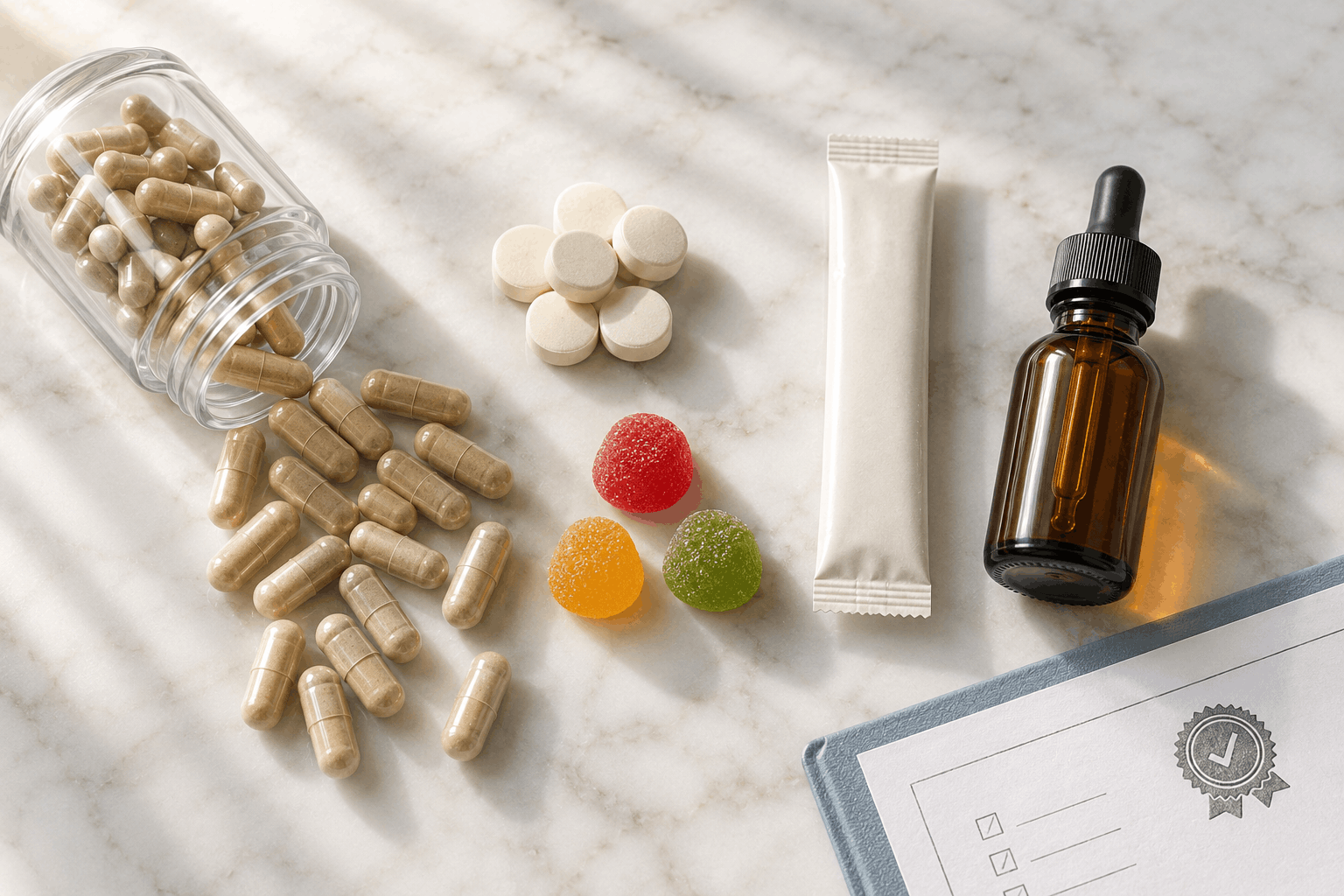
Gummies win new customers. Powders keep the committed ones. Powder is the lowest cost per serving, lets a serious user set their own dose, and avoids the stability problem entirely because the creatine stays dry. Unflavored tubs, flavored blends, and single-serve stick packs all have a place, and stick packs in particular suit the same on-the-go buyer the gummy attracts.
Capsules and tablets cover the customer who wants no taste and no mixing. They are also the simplest format to keep on label claim.
Brands that sell a gummy and a powder together are not splitting one customer in two. They are selling to two different people, and often to the same person at two different points: the gummy first, the tub once the habit sticks.
Ask for finished-product potency data, not a certificate of analysis for the raw creatine. The raw material is almost never the problem. What matters is how much creatine is in the gummy after it has been cooked and cured.
Ask how the product performs over time. Stability data should show creatine content, and creatinine, at intervals through the shelf life you plan to print on the bottle.
Ask who audits the facility. A GMP claim on a website is self-reported. A certification such as NSF/ANSI 455-2 means a third party has inspected whether finished-product specifications exist and whether lots are tested against them.
Ask where the gummies are made. Many suppliers selling creatine gummies do not produce them and cannot tell you much about the process. And ask whether the same partner can produce your powder and capsule formats, so that one quality system stands behind the whole line.
Eagle Labs manufactures creatine supplements in the United States, at our own facilities in Florida. Our gummy program is white label: creatine gummies are developed by our research and development team, made on our own lines, and packaged under your brand. We do not broker gummies from another producer, which means the people answering your questions about the formula are the people who make it.
Creatine powders, stick packs, capsules, and tablets are produced as custom contract manufacturing, with formulation, flavor development, packaging, and fulfillment handled in-house. A brand can launch a gummy and a powder with one partner and add formats without requalifying a new manufacturer each time.
Eagle Labs is NSF certified for dietary supplements, skin care, and OTC drugs. Additional certifications include USDA Organic, Health Canada, Halal, and SSCI. Minimum orders are 1,000,000 gummies, 5,000 bottles or pouches for powders, 100,000 sticks for stick packs, and 300,000 capsules or tablets (5,000 bottles at a 60-count). Those are production-scale numbers, set for brands with established sales or a funded launch.
The brands that will own creatine over the next few years are the ones whose products test at label claim when a retailer, a competitor, or a customer with a lab account checks. That is decided by the manufacturer. Tell us which formats you are planning and your expected first production quantity, and we will come back with an approach, a minimum, and a timeline.
A creatine gummy manufacturer formulates and produces creatine supplements in gummy form, including cooking, depositing, curing, testing, and packaging. The difficult part is keeping the creatine intact through a process that involves heat, moisture, and acidity.
Creatine converts to creatinine when exposed to water, heat, and low pH, all of which are part of making a gummy. Products that are not formulated and tested for this can lose much of their creatine during production or on the shelf.
Less than a scoop of powder. Research doses are typically 3 to 5 grams a day, so a full serving usually takes several gummies. Serving size should be settled early, because it drives cost per serving and bottle count.
Both, if the brand can support them. Gummies bring in new and casual users. Powders serve committed users at a lower cost per serving. Capsules cover buyers who want neither taste nor mixing.
1,000,000 gummies, 5,000 bottles or pouches for powders, 100,000 sticks for stick packs, and 300,000 capsules or tablets.
Yes. Manufacturing takes place at our facilities in Florida, with fulfillment from Florida and Utah.
Read More